
An interesting addition to the story about Research in Motion’s (RIM) full-color BlackBerry PlayBook tablet due out in 2011. We mentioned here that both Kindle and Kobo were ready to provide eBooks for the iPad competitor. This story at the Register tells us that in fact Kobo will come preloaded on the device. While we can imagine the Kindle App for PlayBook will be ready launch day, Kobo’s preloaded status will give their bookstore the high ground.
Oct 01
An Article that Kills the Lies that want to Kill the eBook Revolution.
Many, many thanks to Jorgen for a link to an excellent piece by Marion Maneker at BNET.com called “Are E-Books Killing the Literary Novel? Nonsense.”
Read this article because it cuts right through publishing industry lies against digital publishing, and shows us the essential truth of the eBook Revolution.
If you’re a writer, small publisher or lover of quality books, you have to read this article.
Sep 30
Kobo Releases Wireless eReader – Border Sells it for $140.00
Read this ZDNet story about eBook partners Kobo and Borders releasing the $140 Kobo E Ink WiFi eReader. Available November 1st the $139.99 device will build on Kobo’s first eReader version that ran with USB connection and $150 price tag (it started the eBook Reader price-war). With the new untethered device ready to compete in the ever evolving eBook Marketplace, one looks forward with anticipation to Christmas pricing.
Get the specifics on the Kobo wireless eReader right from the horse’s mouth.
Sep 29
The Future of eBooks Now.
A great link here from Jorgen to a FutureBook.net post called: “We’ll all lose money. And then we’ll learn.” An informative piece that updates the constantly updating eBook marketplace as it relates to pricing, author profits and piracy.
I think the goal is clear when dealing with piracy and file-sharing: “Affordable pricing is the key.” And as explosive as the market is, time is still required for trends to be established and understood.
A note here regarding the post’s title: The status quo will “lose money,” just as established authors might see a temporary adjustment in their cash-flows. But the vast untapped resource of authors who were shut out of the old (Bestseller or Die) system will actually start to make money from their titles. After that, talent (and luck) will decide who makes a living as a writer.
Sep 28
Research In Motion offers the PlayBook Tablet
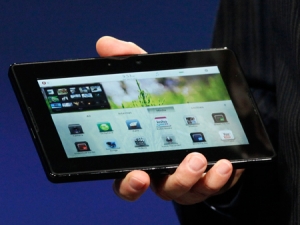 Research in Motion broadens BlackBerry horizons by offering the PlayBook tablet computer. The Monday announcement came at a developer’s conference where the new full-color tablet is positioning to compete directly with Apple’s popular iPad. Proof of this confrontation comes in RIM co-chief executive, Mike Lazaridis’ comment that the PlayBook would “offer an uncompromised Web experience.”
That’s a dig at Apple’s unfathomable decision to ban Flash plug-ins, Apps and components from the iPad. (Unbelievable considering the near total web adoption of the Adobe Flash developing software.)
The PlayBook features a 7-inch screen, Flash-capable video and a front and rear high-def camera. Thin at just 9.7 millimeters and weighing in at 0.9 pounds, the device is slated for a 2011 release. No price for the PlayBook was mentioned.
BlackBerryRocks.com has the full specifications of the PlayBook here.
GearDiary has a post entitled: “Kobo And Amazon Confirm eBooks Will Be Big On the PlayBook” so that’s as good as a starter’s pistol, yah?
The eBook Revolution continues to explode!
Sep 27
Adapt or Die in the eBook Revolution
In any revolution, the old guard must adapt to the new order or risk becoming irrelevant. Here we’ve got a link to a Winston-Salem Journal post on book giant Border’s shrewd moves to stay in the game. As digital publishing suggests an end to bricks and mortar locations, we see property owners and book sellers like Borders and Barnes and Noble joining the eBook revolution while pressing the advantage they have over Amazon and other ‘virtual’ stores.
They’ve all got physical locations to bring their readers to, remembering that all readers are not created equally and while some have embraced the ease of the wireless download others still enjoy the social aspects of reading like browsing shelves and talking titles at book clubs.
Sep 25
eBooks Lighten the Load for Students
The Western Front Online offers some words of wisdom here about the future of eBooks and gives some compelling reasons why textbook publishers should get into the game.
Sep 24
The Future of the Book by IDEO
Ok. Many thanks to Jorgen for this video from IDEO. It’s an interesting look at (possible) futures of the book.
The Future of the Book. from IDEO on Vimeo.
Sep 23
eBooks and Agency Pricing
Thanks to Jorgen for this link to FutureBook.com and a story that explains the negative impact of the agency model for pricing eBooks, and how it’s set to help publishers and nobody else.
Hey, that just leaves readers and writers out in the cold, which is a setup that dragged traditional publishing into the sewer. The difference now is piracy will pick up the slack the same way it did during the early days of digital music publishing.
Let’s hope that thoughts of the agency model for pricing will die a quick and quiet death.
Sep 22
The eBook Market Continues to Prep for Christmas
Back in July we mentioned Borders selling the Aluratek eBook Reader Pro for $120. Well, they’ve now dropped the price of the Aluratek Reader to just $99. Check out the specifics at Borders here.
Its exclusive Reflective Light LCD Screen Technology is not the E Ink display used by industry leaders Kindle, Kobo, Nook and Sony, but the makers claim it is easy on the eyes, good on batteries and delivers the goods without any flashing or flickering.
Having read eBooks now on the Sony Reader, Nook and my HP Mini via Adobe Digital Editions I can easily see the jump to the Aluratek device. As I’ve mentioned before, it’s just a delivery system for eBooks, and each has its own pros and cons. In this case, the extremely low price makes it perfect for mainstream consumption.




Good Reads

SPECIAL OFFER!